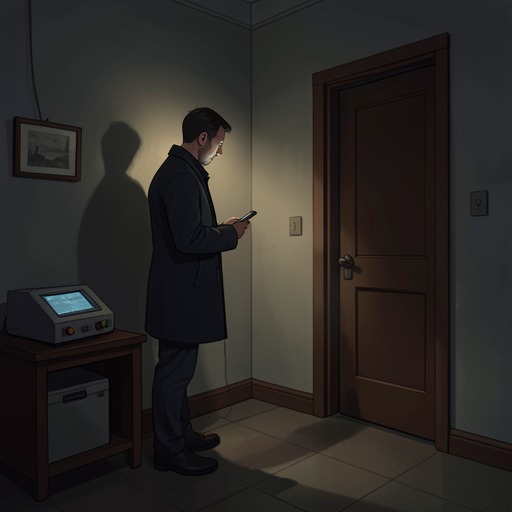
Piet Hoffmann’s nine years as a police infiltrator
Three SecondsPiet Hoffmann’s nine years as a police infiltrator make criminal identity an institutional construction as much as a personal disguise. Recruited on his release from Österåker prison, he is developed by Erik Wilson into a credible underworld figure through a police intelligence database and successive false reports. The arrangement gives the police access to serious crime, but also lets them hide the crimes and failed investigations generated by the work. Hoffmann’s prison infiltration is the career’s most concentrated test: the identity built to protect him becomes the danger from which he cannot simply walk away.
Recruitment and the manufactured record
The nine-year period begins on Hoffmann’s first day of freedom from Österåker prison, when Wilson meets him at the gate and drives him roughly fifty kilometres to Stockholm. Wilson then records the first observation of Hoffmann in ASPEN, the criminal intelligence database. It is presented as a concise account of Hoffmann leaving prison in the company of former convicts and known criminals with alleged links to the Yugoslavian mafia. From that moment, the entry is available to police officers who search the database for information about him.
The record does not remain a neutral account. Wilson adds successive observations that make Hoffmann appear more dangerous, violent, and ruthless, varying the wording and degree of misinformation until the database presents him as one of Sweden’s most dangerous criminals. Reports place him near property raided over suspected arms dealing and near a murder scene. The manufactured history is meant to withstand scrutiny: Hoffmann and Wilson understand that an infiltrator’s background must look convincing enough to survive the questions that could expose it.
That fiction is also the basis of their working relationship. Wilson has spent nine years as Hoffmann’s handler, and the prolonged contact has taught him to judge when Hoffmann is telling the truth. When Wilson studies the evidence from a shooting and compares it with Hoffmann’s account, he trusts that account and concludes that Hoffmann was not the shooter. The confidence between handler and infiltrator is real, but it operates inside a system that depends on falsified records and concealed cooperation.
Entering the prison role
Hoffmann’s undercover work eventually takes him into Aspsås Prison, although he has never been inside its walls before. He has studied the prison from outside, mapping its buildings from the church tower and learning about the prisoners and staff in Block G with Wilson’s help while on remand. On arrival, he is escorted through the security entrance, searched, issued prison clothes, and left in a sterile waiting room. After ten days, he has spent twenty-three hours a day in a five-square-metre cell, without visitors or ordinary media. The operation’s preparation cannot remove the reality of confinement.
A guided tour teaches him the unit’s routines, including where to go and when lock-in occurs. He must absorb the rules of a place that is now, for the purposes of the operation, his home. Before the other prisoners return, he chooses a visible seat in the television corner. He knows the backgrounds of all fifteen men in the unit and can watch them arrive, but he also wants them to see him: a newcomer who does not hide, who takes a familiar chair and marked cards, and who begins playing solitaire without asking permission. The performance establishes his presence before he has earned acceptance.
He is looking in particular for Stefan Lygas and Karol Tomasz Penderecki, two of the four members of Wojtek serving long sentences at Aspsås. They are his intended helpers in removing the existing competition and taking control of the prison drug market; if his identity as Paula is exposed, they are also among those who could kill him. Their preparation of the ground includes circulating information about his supposed criminal history. Through Stefan’s lawyer, they obtain copies of Hoffmann’s criminal records, intelligence and prison files, and most recent judgment. The fabricated dossier that Wilson built outside the prison thus becomes evidence for Hoffmann’s credibility inside it.
At the first supper, two older prisoners demand to see his papers. Stefan and Karol Tomasz move to intervene, but Hoffmann signals them to hold back and allows the challenge to proceed. He answers without surrendering control of the exchange, turning the test into an opportunity to define the terms on which others approach him. Respect in the unit must be performed and negotiated; a police-created history alone cannot secure it.
The operation’s gains and its exposure
Hoffmann’s first move against the prison market is concrete and consequential: he uses forty-two grams of amphetamine with a purity of thirty per cent to bring down the three principal dealers in Aspsås Prison. Reports reach Warsaw and the deputy chief executive, and the next stage begins. The operation’s apparent progress depends on Hoffmann acting as the criminal his police record claims he is, while the danger of that performance increases with every step.
When he fears exposure, the prison offers no ordinary escape. He demands transfer to voluntary isolation. Ten members of the prison riot squad enter Block G: six remain to deter renewed violence, while four escort him to the isolation unit in Block C. The move changes his immediate surroundings but not the basic confinement. The unit resembles an ordinary prison wing, with a staff room, television corner, showers, kitchen, and table tennis, and its residents can move around within it; the separation lies in the fact that they do not encounter prisoners from other units. Isolation affords protection from the people who might recognize him, but it also makes the operation’s threat impossible to ignore.
Eventually Hoffmann realizes that one of the people he had counted on for protection and escape has betrayed him. The exposure reverses the meaning of the relationships on which his prison position was built: helpers and cover are no longer assurances of safety. Earlier, he had treated death at a distance as part of the work and its demands for credibility. But he had directed the operation, and a murder could leave him facing life imprisonment. The professional role that required him to accept danger now places responsibility for its consequences on him as well.
The hidden cost of the nine years
The novel connects Hoffmann’s career to a wider practice rather than presenting concealment as an isolated expedient. Its closing factual account states that the Swedish Police Service has used criminals as covert human intelligence sources while denying and concealing the cooperation. Crimes have been marginalized to investigate other crimes, and preliminary investigations and trials have proceeded without the correct information. The same account describes police criminal-intelligence databases and reports as tools for developing suitable, credible backgrounds, with extensive doctoring of information treated as standard practice.
Ewert Grens’s examination of the secret reports gives that cost a measurable scale. Across three hundred and two reports from the preceding year, he finds accounts of informants’ work to uncover one crime giving rise to another, as well as other investigations that collapsed despite relevant knowledge already being held internally. The concealed intelligence had not merely supported Hoffmann’s cover; it had shaped what investigators and prosecutors could know. Lars Ågestam, the prosecutor, had been involved in twenty-three cases in which prosecutions failed after official investigations proceeded without the information contained in the secret reports.
Hoffmann’s nine years therefore link two kinds of manufactured truth: the false criminal identity that allows an infiltrator to enter a closed world, and the incomplete official account that prevents the justice system from seeing what the operation has done. His career depends on being believable to criminals and invisible as a police source. The more successfully the institution sustains that arrangement, the more completely it shifts the risks—exposure, violence, and legal responsibility—onto the person performing the role.